|
Versatile energy harvesting with piezoelectric thin films
7/3/2011 |
|
|
Julien Happich
In a crucial step towards the development of self-powering portable electronics, RMIT University researchers have for the first time characterised the ability of piezoelectric thin films to turn mechanical pressure into electricity. The result has been published in the leading materials science journal, Advanced Functional Materials.
Lead co-author Dr Madhu Bhaskaran said the research combined the potential of piezoelectrics - materials capable of converting pressure into electrical energy - and the cornerstone of microchip manufacturing, thin film technology. "The power of piezoelectrics could be integrated into running shoes to charge mobile phones, enable laptops to be powered through typing or even used to convert blood pressure into a power source for pacemakers - essentially creating an everlasting battery," Dr Bhaskaran said. "The concept of energy harvesting using piezoelectric nanomaterials has been demonstrated but the realisation of these structures can be complex and they are poorly suited to mass fabrication. Our study focused on thin film coatings because we believe they hold the only practical possibility of integrating piezoelectrics into existing electronic technology."
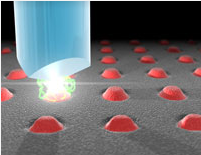
Piezoelectric energy generation, as featured on the inside cover of Advanced Functional Materials. Image: Daniel J White.
Source and image: RMIT University
The Australian Research Council-funded study assessed the energy generation capabilities of piezoelectric thin films at the nanoscale, for the first time precisely measuring the level of electrical voltage and current - and therefore, power - that could be generated.
Dr Bhaskaran co-authored the study with Dr Sharath Sriram, within RMIT's Microplatforms Research Group, which is led by Professor Arnan Mitchell. The pair collaborated with Australian National University's Dr Simon Ruffell on the research.
"With the drive for alternative energy solutions, we need to find more efficient ways to power microchips, which are the building blocks of everyday technology like the smarter phone or faster computer," Dr Bhaskaran said. "The next key challenge will be amplifying the electrical energy generated by the piezoelectric materials to enable them to be integrated into low-cost, compact structures."
|
|
|
|
|
|